How Edge Data Centers Are Transforming the AI Landscape — Without Draining Communities
The headlines about AI infrastructure usually focus on the same handful of mega-regions: Northern Virginia, Phoenix, Dallas, the Pacific Northwest. Hyperscale buildouts pulling gigawatts of grid power, hundreds of millions of gallons of cooling water, and reshaping local utility politics in ways that are starting to attract real backlash. Northern Virginia is rejecting new permits. Arizona is rationing water. Several utilities are pausing data center interconnects entirely.
The next chapter of the AI infrastructure story is going to look different — and a lot of it is going to be written in places like Murfreesboro, Tennessee.
The Shift to the Edge
“Edge data center” used to mean a micro-cabinet at the base of a 5G tower. In 2026 it means something more substantial: real colocation density in Tier 2 markets, sitting close to where people actually live and work. Not hyperscale (millions of square feet, gigawatt power draws). Not micro (one rack in a hardened closet). The right answer for most production AI workloads is in between — and increasingly, the math is pointing toward edge colocation as the structurally smarter long-term bet.
Three forces are pushing this shift:
- AI inference is latency-sensitive. A user waiting on an AI response feels 100ms vs 30ms. They don't feel 500 megawatts vs 5 megawatts. Putting inference racks closer to users measurably improves the product.
- Streaming and content delivery are moving more compute to the edge. Per-user transcoding, personalization, recommendation models, live event encoding — all benefit from running ~10-30 miles from the user rather than 1,000.
- Regulated workloads need data residency. Healthcare AI, financial services, and government workloads increasingly require in-state colocation that hyperscale regions can't satisfy without expensive workarounds.
The Ecological Case for Smaller, Distributed Facilities
This is the part of the AI infrastructure story that doesn't get enough airtime. The public conversation is fixated on the worst-case footprint of mega-region hyperscale — and reasonably so, because those facilities draw tens or hundreds of megawatts continuously and consume staggering amounts of cooling water in regions that are already drought-stressed.
Edge colocation in Tier 2 markets has a structurally different profile:
- Single-digit to low-double-digit megawatts per facility — not hundreds
- Spread across many regional grids instead of concentrated in mega-regions — which avoids the single-grid overload problem that's killing hyperscale buildouts in NoVA and Phoenix
- Closer to existing utility infrastructure — Tier 2 metros have power capacity that hyperscale regions are running out of
- Lower water consumption via modern closed-loop cooling — avoiding the open-cooling water draws that are becoming the most-criticized footprint of hyperscale
- Less network energy — running inference 30 miles from a user uses less long-haul fiber energy than running it 1,000 miles away
None of this means hyperscale goes away. Training frontier models genuinely belongs in mega-facilities. But for the long tail of latency-sensitive workloads — which is most of what end users actually experience — the right architecture is fewer megawatts in more places.
Tennessee's Edge Advantage
Middle Tennessee is geographically and economically positioned to host a real edge data center cluster. Nashville's tech economy has grown enormously — healthcare AI, music industry production, automotive R&D, financial services, and a Southeast logistics hub that all increasingly depend on real-time compute. Middle Tennessee Universities (MTSU, Vanderbilt, Belmont, Lipscomb) plus a growing research ecosystem add academic demand on top of enterprise demand.
Tennessee also offers what mega-regions can't: utility interconnect capacity, no state income tax, lower energy costs than the Northeast, available land, and a regulatory climate that supports rather than rejects new infrastructure. A purpose-built edge colocation facility positioned 30 miles from Nashville is exactly the shape of the next decade.
What Quantum and Biological Compute Look Like at the Edge
The conversation usually stops at GPU AI inference, but the next generation of compute architectures is going to make the edge case stronger, not weaker. Quantum compute and biological/neuromorphic compute have very different power-and-cooling profiles than today's GPU racks — generally lower continuous power draws, very specific environmental requirements, and even smaller deployment footprints. They're not going to be hosted in 100MW hyperscale facilities. They're going to be hosted in specialty edge facilities co-located with research universities, healthcare systems, and applied-research enterprises.
That's the kind of facility Middle Tennessee is well-positioned to host. The combination of academic research density, healthcare scale, and existing technology workforce makes it a natural home for the next two waves of compute architecture, not just the current GPU wave.
Data Suites in Murfreesboro: The Local Example
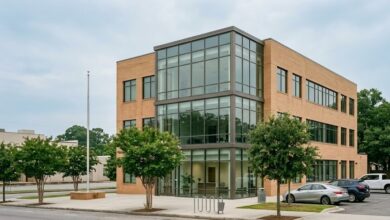
Data Suites in Murfreesboro is the Middle Tennessee instantiation of this edge-AI thesis. Tier 3-ready, 50kW+ per rack, 415V power, modular suite design from 1U to private cages, geographic redundancy from the Nashville cluster, and serving enterprise + national customers since 2016. The facility is built for the new density profile that AI inference and HPC actually need — and at a scale that doesn't strain Rutherford County's grid or water supply the way a hyperscale buildout would.
Edge colocation in Tier 2 markets isn't a compromise architecture. It's the right architecture for most of what AI is going to do over the next decade. And it's the architecture that lets communities like Murfreesboro participate in the AI economy without paying the ecological and political costs that come with hosting the mega-regions' next gigawatt.
Learn more about Data Suites' AI and HPC colocation services in Murfreesboro, Tennessee at mydatasuites.com.