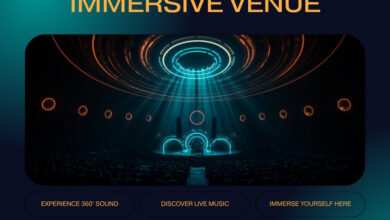
Nashville’s Sphere Question: What a 6,000-Seat Version Would Actually Mean — and Why Nothing Is Signed
Every so often a rumor arrives in Nashville that is too fun to ignore and too early to believe. This is one of them: the company behind the giant glowing orb in Las Vegas has been talking, quietly and preliminarily, about building a smaller version here.
Before anyone starts planning a night out — nothing has been committed, no site has been secured, and no deal has been announced. What follows is what has actually been reported, and what the numbers would mean if it ever happened.
What has been reported
The story surfaced in March 2026, when reporting indicated that representatives of Sphere Entertainment had held conversations with Nashville figures who would be natural partners on a project of that size. The talks were described as very preliminary. The company did not comment.
By April, the conversation had a possible address attached: reporting pointed to a scrapyard property on the East Bank — the same stretch of riverfront across from downtown that is already being reshaped around the new stadium and a decade of planned development.
That is the entire factual record. Talks happened. A site was floated. Nobody has signed anything, and it is not clear whether other Nashville locations are also being evaluated.
The number that matters is 6,000
Anything built here would not be the Las Vegas building. That distinction is the whole story.
The original Sphere, which opened on the Vegas Strip in the fall of 2023, cost somewhere in the neighborhood of $2.3 billion and seats roughly 17,600. It is one of the most expensive entertainment venues ever constructed, wrapped in an exterior LED skin visible from most of the valley.
What has been discussed for Nashville is a roughly 6,000-seat version — about a third the size — mirroring the smaller model the company has already committed to building at National Harbor in Prince George's County, Maryland, just outside Washington. That is the template: not a copy of Vegas, but a scaled-down format the company appears to want to replicate in a handful of markets.
Six thousand seats is a meaningful number in this town. It would slot in above the Ryman, which holds about 2,300, and below Bridgestone Arena, which holds around 20,000 for concerts — landing in the same broad range as Ascend Amphitheater. Nashville has no shortage of rooms. What it does not have is a room where the room itself is the attraction.
Why Nashville, and why now
The logic is not hard to follow. Nashville draws enormous numbers of visitors specifically to experience live music, and it has spent the last decade converting that appetite into permanent infrastructure — a new stadium, a reimagined East Bank, a Super Bowl booked for 2030, and a downtown that now functions as a year-round destination rather than a weekend one.
An immersive venue is a different product from a concert hall. In Vegas it functions less as a place to see a band than as a thing tourists go inside — which makes it a natural fit for a city whose visitor economy is already the engine. It is also, bluntly, the “Vegas in Nashvegas” thesis made literal.
The reasons to stay skeptical
Preliminary talks are just that. Projects of this scale die quietly all the time, over financing, land assembly, zoning, incentives, or a parent company's balance sheet. The East Bank is among the most contested real estate in Tennessee, with a long queue of proposals ahead of any newcomer. And a smaller Sphere is still a nine-figure building at minimum, in a city where the public conversation about subsidizing entertainment venues is already well underway.
The honest summary is short. Someone made a phone call. Someone else took the meeting. That is a long way from a groundbreaking — but it is not nothing, and it is worth watching.
We will keep updating this hub as the picture develops. More on the city's event decade: what the 2030 Super Bowl is already setting in motion.